EUTROPHICATION ( Algal Bloom)
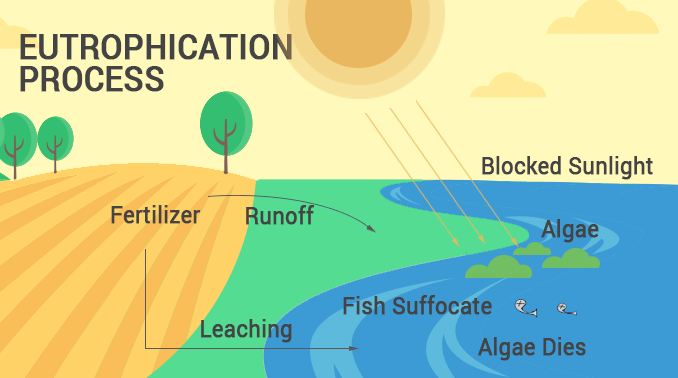
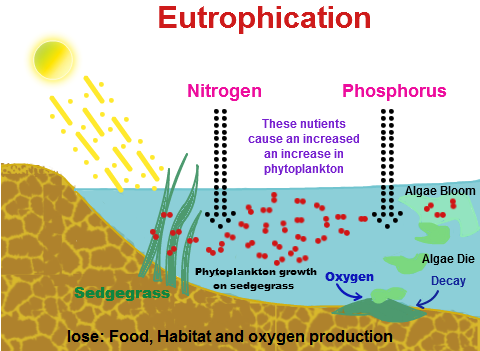
Algae grow in the lake,sea feeding on nutrients in the water. Algae grow better when more nutrients (nitrates and phosphates) are present in the water column. A small increase in algae biomass has no adverse effects on the ecosystem and can even lead to an increase of certain fish species populations. An overgrowth however can lead to an algae bloom which may disturb the water. The algae may keep out the light and when they eventually die, they are decomposed by bacteria which consume oxygen in this process so that the water may become temporarily anoxic (hypoxia) which may be toxic to aquatic life. An enrichment due to excess of nutrients to the water is called eutrophication and may result in an explosive growth of algae. Depending on the environment (quiet bay or rough seas) and the type of algae (microscopic or macroscopic), a ‘bloom’ can be observed in different forms: foam or a green tide on the beach.
Eutrophication is one of the causes of the deterioration of water quality. In the North Sea and the English Channel, this is mainly due to human activities. Nutrients can have a natural or anthropogenic origin and come from:
- Domestic wastewater
- Industrial waste
- Agriculture (fertilizer use)Atmospheric deposition of nitrogen (livestock and gases)
The overload of nitrogen, phosphorus and other organic material can result in a series of ‘side effects’. The main effects of eutrophication are:
- Increasing biomass of phytoplankton resulting in ‘algae blooms’.
- Hypoxia (reduced dissolved oxygen content of a body of water).
- An increasing number of incidents of fish kills.
- The water can have a bad taste, colour and odour which has a negative impact on tourism. Governments have to invest more in waste water treatment.
- Decline or loss of species biodiversity (commercially important species may disappear).